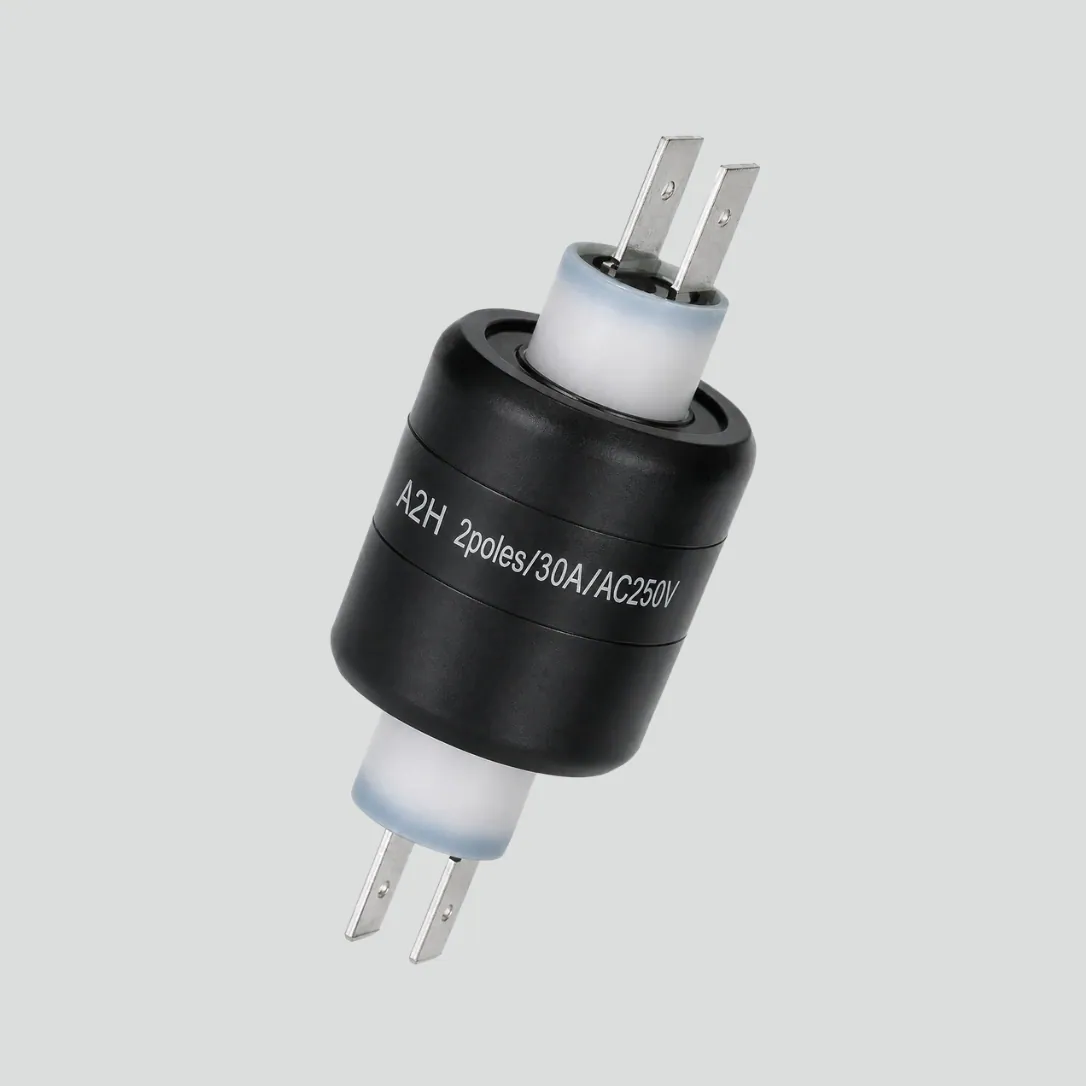
Mercury Type
Asian Tool Slip Ring
Uses a liquid mercury contact interface for continuous rotation, delivering ultra-low electrical noise and near-zero contact resistance with no maintenance required.
Features
- Very low electric noise
- Very low cost
- Very low contact resistance (less than 1 milliohm)
- No maintenance and better reliability than traditional slip rings
- Suitable for signal and power transfer of rotating devices or instruments
Applications
Need Customization?
We offer customized solutions for specific requirements.
Mercury Slip Ring — Model Selection
4 models| Model | Conductor Poles | Current (Amp) | Voltage AC (V) | Max. Freq. (MHz) | Max. RPM | Operating Temp. Max/Min (°C) | Rotating Torque (gm-cm) | Insulation Resistance |
|---|---|---|---|---|---|---|---|---|
| A2S | 2 | 4 | 250 | 200 | 2000 | 60 / -30 | 75 | >25 MΩ |
| A2H | 2 | 30 | 250 | 200 | 1800 | 60 / -30 | 200 | >25 MΩ |
| A4H | 4 | 30/4 | 250 | 200 | 1200 | 60 / -30 | 400 | >25 MΩ |
| A6H | 6 | 30/4 | 250 | 100 | 300 | 60 / -30 | 700 | >25 MΩ |
Technical Specifications
About Electrical Rotary Joints (Slip Rings)
Powering Continuous Rotation. Essential electromechanical devices that enable continuous, unrestricted rotation while maintaining secure and stable electrical connections.
A slip ring is an electrical connector designed to conduct current or data across a rotating interface, replacing the need for dangling wires that would inevitably twist and break.
Key components
- Rings
- Circular, conductive tracks (usually made of copper or a precious metal alloy) mounted on the rotor (the rotating part)
- Brushes
- Stationary, conductive contacts (often graphite, carbon fiber, or a precious metal alloy) that rest on the rings and transfer the electrical current or signal
- Housing/Stator
- The fixed enclosure that holds the brushes and provides the mounting points for the stationary side
Typical applications
- Packaging Machinery: Transmitting power and control signals to rotating sealing heads or label applicators
- Cranes & Winches: Providing power and control signals to the rotating drum or trolley
- Robotics & Automation: Enabling unlimited joint movement in multi-axis robots without damaging wiring
- Turrets & Indexing Tables: Supplying power and control for precision positioning systems
- Wind Turbines: Transmitting pitch-control signals and monitoring data from the rotating hub to the nacelle
- Medical Equipment (e.g., CT Scanners): Handling high-speed data transfer and power delivery during continuous rotation